A short history of smoking

It’s a long time since I dreamed of smoking cigarettes, the delicious zing down the back of my throat and into my lungs, the exhilaration that comes with each puff. The terrible taste left behind such as you’d need to chew on mint gum or brush your teeth more regularly to freshen your mouth. 

I began to smoke in my early twenties, a late start, when the man I was to marry smoked Galois cigarettes and gave the impression of such comfort in the short colourful sticks of tobacco, the brightly lit end, the ash as it fell, I could not resist. I thought it might help me overcome other hungers, for food and control, at a time in my life where my self-confidence was non-existent. Where every undertaking was fraught with peril.

 To smoke as my father once smoked, as every one of my sisters and brothers once smoked, as most of my friends smoked, brought me into a club of confidence even as I worked in a Community Health Centre where nicotine was on the nose and the filthy habit frowned upon. Even the director of medicine at the Southern Memorial Hospital next door smoked, and all of us indoors. 

Meeting rooms were thick with the fog of cigarette smoke floating above our heads and ashtrays were full to overflowing in all the consulting rooms, even at the front desks for visitors to stub out their cigarettes on arrival. It seemed then that everyone who was anyone smoked, even as the word was well and truly out: smoking was dangerous. It killed. 

For five years I kept up the habit. One New Years Eve – both the man and I had married by then – we decided to stop after we realised how this habit controlled us. But we resumed soon after over an argument about what to cook for dinner, his preference pork chops, or mine, chicken schnitzels.  I stormed off to the shops for yet another pack of Alpines. 

 We made up over cigarettes and more, and in time were back into the habit, until my youngest brother chucked the habit and the guilt bit deeper. Then another good friend followed his wife into not smoking. Our social times together were harder. It was not so okay to light up a cigarette in a restaurant before the meal came when you sat with friends who made conversation with longing and determination in their eyes. For them and with them as a model and with the beginnings of publicity campaigns that nipped at your heels I re-considered the need to stop smoking cigarettes. 

Then I fell pregnant and what was hard became the easiest thing imaginable. On top of which I took to putting the money we spent on cigarettes into a separate account. After three months, we had saved enough money from not buying cigarettes, to take our no longer smoking friends to Stephanie’s Restaurant in Hawthorn. An expensive proposition but we had saved enough for dinner for four, which in those days came in at a whopping $20.00 per head, not including wine, which I no longer drank while pregnant.

For years afterwards I kept the thought alive: if things get too hard, if someone dies or if something feels impossible I can always take up smoking again. These last couple of decades the desire has gone, and I have stopped dreaming of smoking cigarettes. The thought now fills me with a type of terror, as if a single puff of smoke would constrict my airwaves and send me closer to my death. 
Nothing is for free

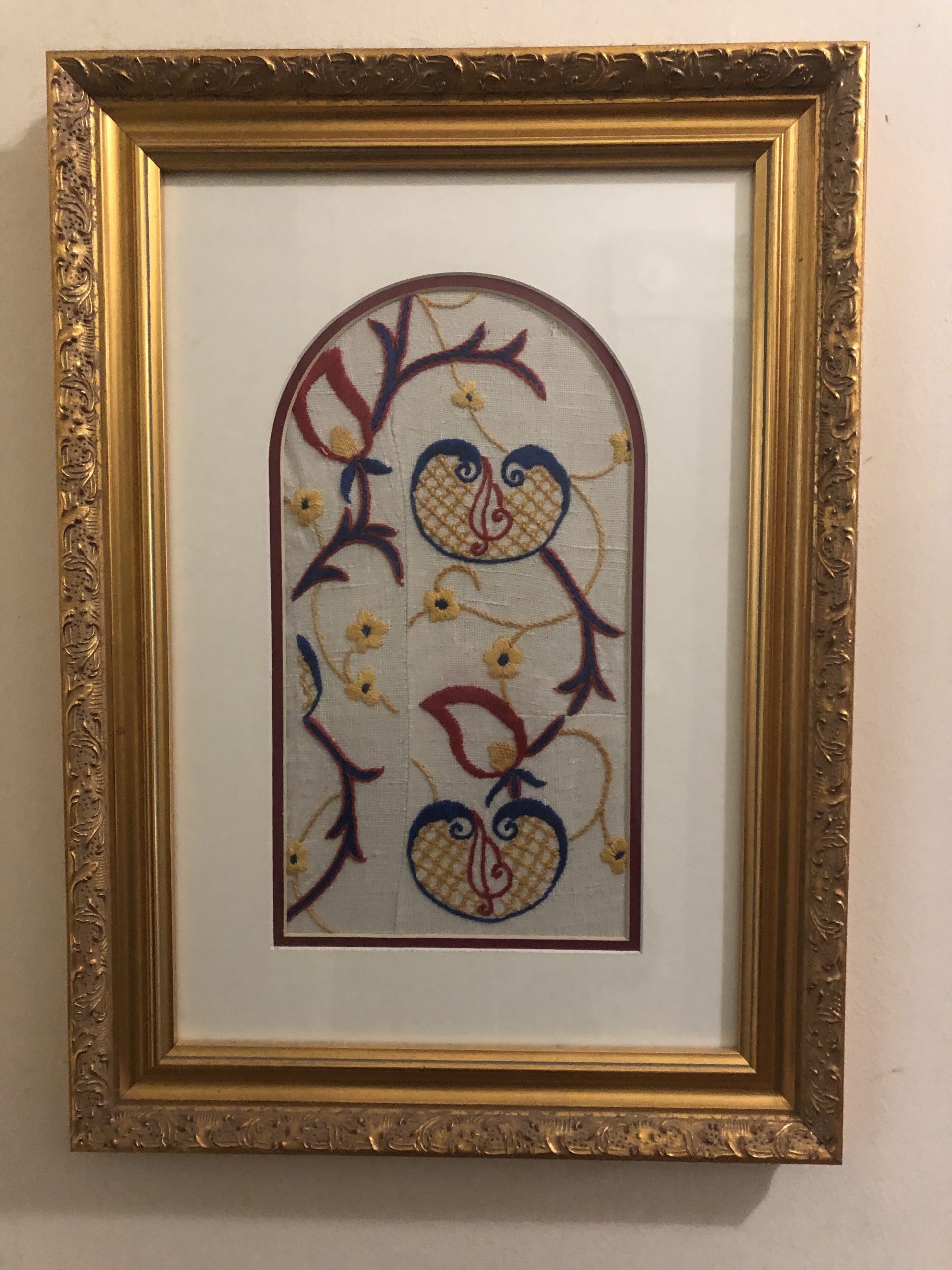
When she was not yet twenty, my mother walked the streets of Haarlem with her new young man. In a bevelled shop window, one that displayed fabric and other haberdashery, she saw an embroidery kit. In those days all the rage. A kit that once set up, enabled the craftsperson to embroider great swathes of fabric and then, following a pattern, turn the sheet of fabric into an elegant, fitted blouse. 

My mother hinted to the man on her arm that she would love to possess this kit.  My mother, master manipulator, as were most women of her generation. The only way to get things was to hint at your desire. Women were not meant to have desires then. 

She did not say, ‘Could you please buy this for me?’ Instead, she said, ‘I’d love that blouse.’ And then later, on the return trip, she looked longingly into the window again and admired its perfection. ‘I’d love to be able to embroider that,’ she said. And finally, as if her young man had not yet heard, ‘What I would do for such a blouse.’ 

And my father – for the man on her arm became my father in less than two years – took the bait as ceremoniously as he could manage. In later years he came to hate my mother’s desire for things. He came to resent her wishes and her needs for possessions and for babies. These became things that weighed him down. Especially his children. But on that day, my mother’s every wish was his desire. 

‘Why don’t I buy it for you?’ he asked, as if the thought had never entered her mind. 

‘Would you?’ she said, seemingly incredulous at such generosity. 

‘My pleasure.’ And my mother beamed her delight. A no reason present. Something just for her. Something that came into her possession purely through the power of her allure. 

‘You can’t keep it,’ my oma said when she saw her daughter’s gift. ‘He’s not your fiancé. You’re not serious about him. You have to give it back.’ But my mother who by then had learned enough to disregard her mother’s commands, skittered off to her father and pleaded with him to make her mother see reason. 

My mother was the first-born daughter of two daughters among a host of sons. She was her father’s darling. He could not resist her wishes and the blouse became my mother’s pride and joy. She stitched the elaborate swirls night after night and wore the blouse on the first day of spring in the April when she and my father had finally approached the idea of marriage.

It was war time. There was no time, but my father needed to create his own metaphorical blouse of religious conversion. He needed to visit the priests for weeks on end to convince them that he had learned the doctrines of the Catholic Church well enough that he could be baptised in this new religion. Otherwise, my mother’s parents, even her beloved father, would not condone such a partnership. 

In the August of her twenty first year my mother became a married woman and the rest, as they say, is history.

All those years between then and now the blouse travelled over the sea from Holland to Australia and for years my mother wore it when the weather was kind, and her body was not too stretched. For her body swelled every year with each new baby and by the time her eleventh child came into the world, still born, with nine living children in her care, the blouse had lost its allure. 

It was worn at the seams so much that my sister who took possession that day cleaning out our mother’s cupboards was dismayed. She had planned to restitch the blouse, but this garment was too far gone to get back its original shape.

So, my sister formed a plan to find a way of commemorating our mother through her blouse. She cut out sections of the material, large pieces that held together without stains or gashes, and these she framed into a series of pictures, each gold rimmed, each carrying the imprint of the years.  Today they hang in our various houses. 

I thought of my mother this morning as I went out to collect the newspaper. I thought of how cruel I had been to her in my later years, in the years after I had babies of my own. I thought of the way I was civil to her and invited her to my children’s birthdays, but I did not embrace her, nor encourage them to embrace her as their grandmother. The way they were not free to love her in a way I hope my grandchildren are free, and encouraged by their mothers, to love me. 

When I was a young mother I felt a certain honour in my decision to exclude my mother in this way. Subtly, insidiously, not loudly so others might notice, but loud enough so that she could feel the sting of my disappointment in her. 

My mother whom I had admired in childhood and even into my adolescence. My mother whom I loved above all others, even into my early twenties when something snapped inside of me and turned me away from her.

And now, like my mother’s blouse, our relationship can be cut into individual pieces to show off the beauty of the embroidery, to hide the stains and gashes in the fabric, and to hang the pieces framed on a wall somewhere as a reminder of what once was.