My husband has gone back to sharpening knives. Not for their murderous properties, but for the sheer beauty he finds in the smooth knife-edge, the blade that can cut a swathe through the hairs on his arm.
I find it almost unbearable to watch, the blade so sharp it could splice a single hair.
My husband pulled out several of his sharpening stones the other day for the purpose of washing them down in readiness for use. They form part of his collection. Several dull coloured blocks of fine pressed stone against which he rubs each knife blade.

My husband also has a sharpening wheel in the workshop outside, his go-to sharpening stone when friends or relatives come round with their small collection of kitchen knives, blunted from too much use.
My husband likes to relax at the wheel and move the blade up and down the surface of the round stone, as it turns slowly with a steady flow of water dripping over its surface.
I do not understand my husband’s passion for knives other than the passion of one who likes to collect things. Who likes to have in his possession an example of every variety of knife available: cooks knives, paring knives, fish knives, bread knives, Japanese and German knives, pocket knives and cleavers.
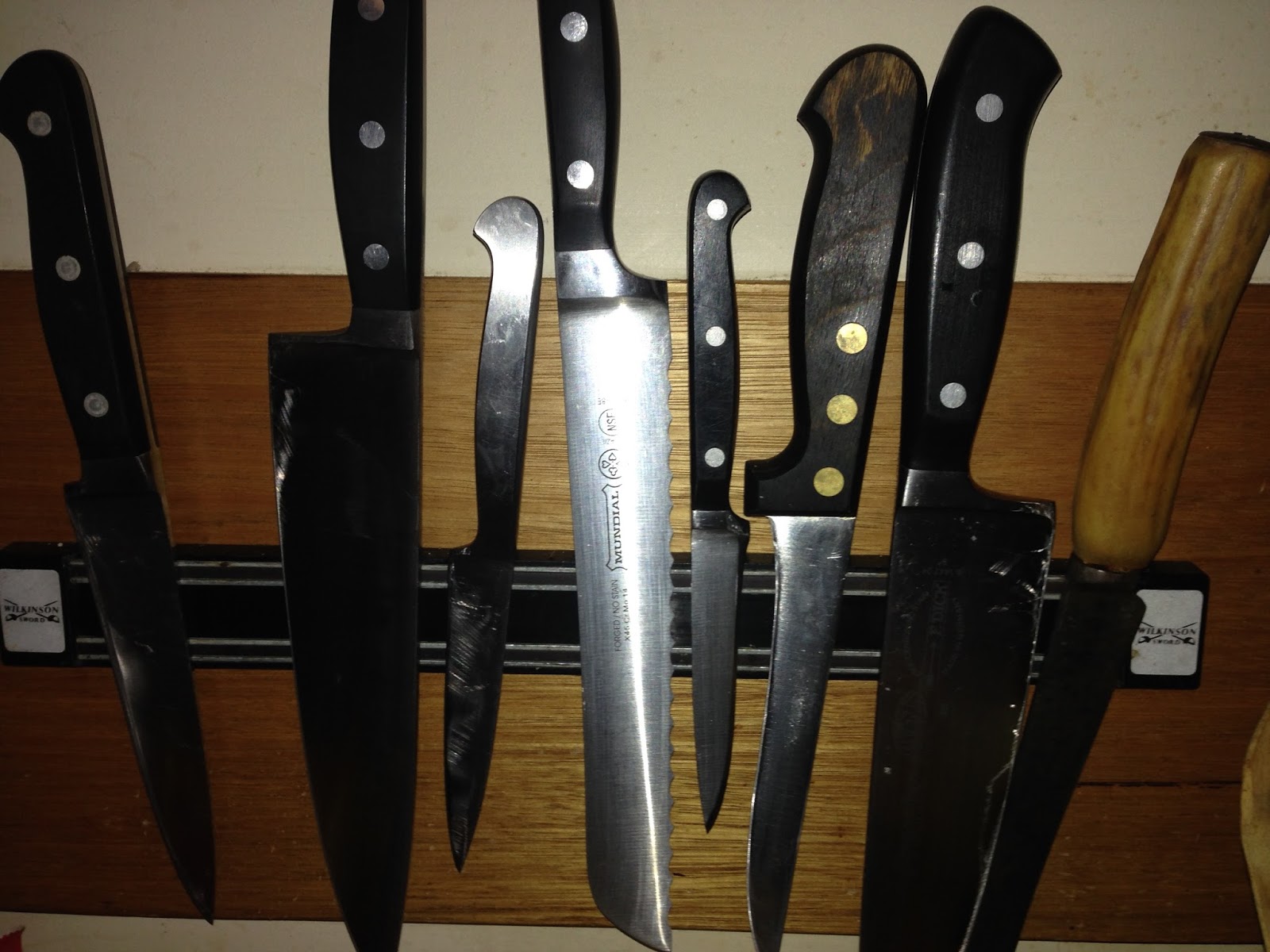
Many of these knives we use, others lie tucked away, hidden at the bottom of drawers and wrapped in tea towels or swathes of calico cloth.
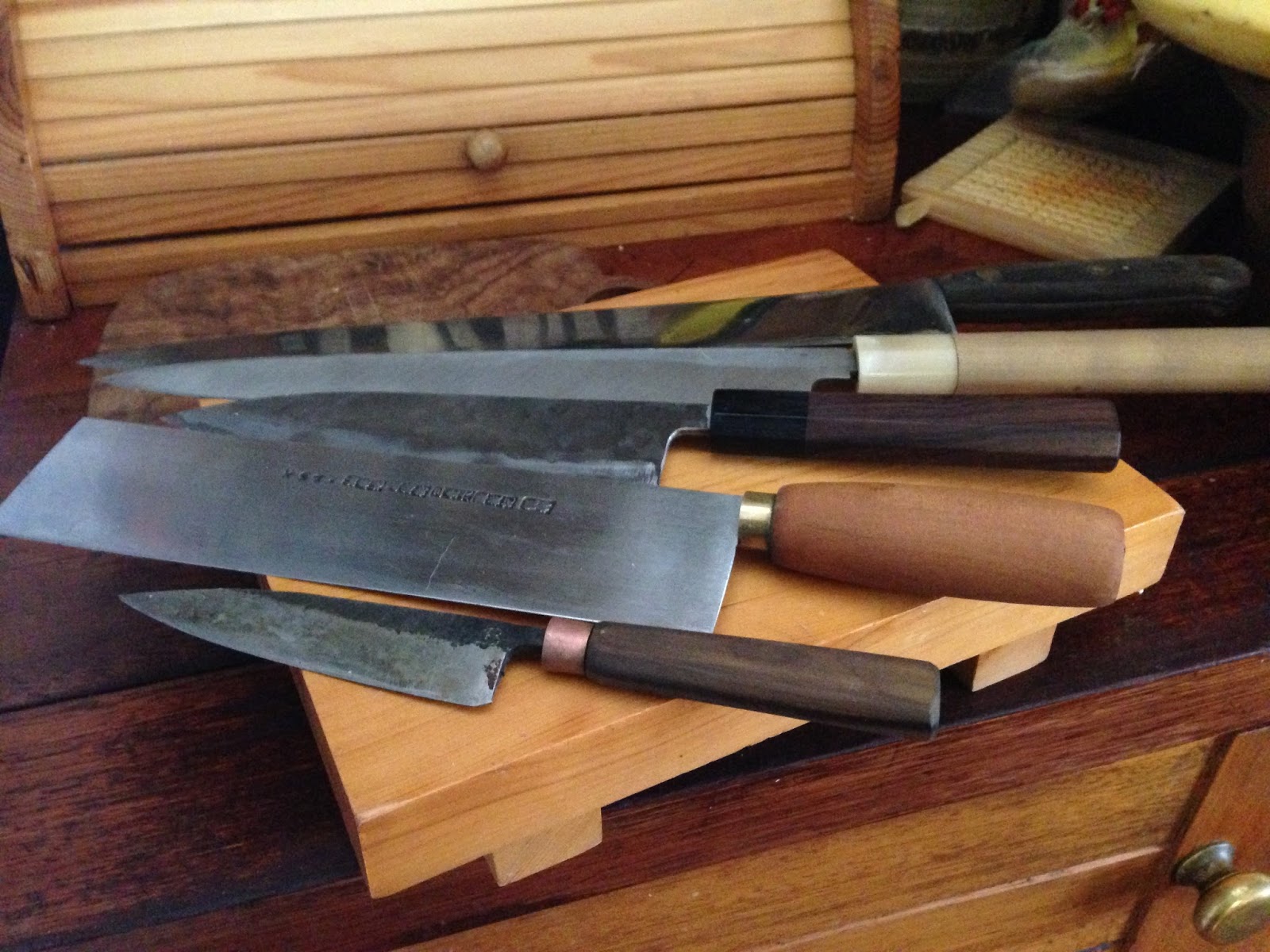
Recently, my husband came across a man who makes knives for a living, a blacksmith of sorts, who forges his blades to your specifications.
The knives come back in rustic form, without handles, unless you pay extra. But they are good knives, heavy to hold and excellent for all manner of food preparation.
When we go away for a holiday, it is not unusual for my husband to take along a couple of knives from our kitchen. Even when we stay with friends, he does not trust the quality of their knives for cooking and so he brings his own.
Besides his love of knives, my husband has multiple interests – woodturning, book binding, jewellery making, photography, genealogy, gardening, coin collecting, cooking and preserving – which I pitch against my one obsession, writing.
It puts me in mind of my father, his passion for activities beyond home, not that he was passionate about home. My father collected books, and photography
equipment. He had dreams of building a yacht in our back yard and bought books on the subject.
equipment. He had dreams of building a yacht in our back yard and bought books on the subject.
He wanted to make something of himself.
Who does not want to make something of themselves? And who does not suffer disappointment in the struggle.
I thought of these words in the shower this morning as I pondered the fate of my would-be book: Marlon Brando’s words from On the Waterfront, ‘I could’a been a contender’.
Yesterday, I met a young woman who will help me to transfer this blog into a WordPress blog.
I don’t know whether I dare say this out loud in case the people who currently host my blog, the people at blogspot will object. Not that there are people behind these ventures, real flesh and blood people who can read these words and object to my infidelity.
There are matrix like operations behind the scenes that control these processes, I suspect, owned by someone, but I do not understand the workings of these things and therefore have enlisted the help of the technologically savvy.
I started this blog in 2006. My young assistant remarked on this, as if it were a long time to be
blogging. As if it were a strange thing to continue on such a path instead of moving onto something new.
blogging. As if it were a strange thing to continue on such a path instead of moving onto something new.
I think again of my husband’s interests. When one starts to lose its allure he can move onto another, and back again.
There’s diversity there.
But my passion is relentless. It does not shift, except perhaps in its content.
There’s always something different to write about, and yet I am fearful these days of almost every word I write, in case it offends someone.
The thought police are loud in my head. ‘How can you say that?’ How dare you utter such things out loud?
Do all children learn this?
This business of keeping things to yourself, this business of holding thoughts inside for fear of offending someone.
This business of keeping things to yourself, this business of holding thoughts inside for fear of offending someone.
Lately, I find myself trying to be more circumspect. At meetings with colleagues, I try to ‘hold
my tongue’.
my tongue’.
Another of those expressions from when I was a child and learned to hold my tongue, but it takes such an effort.
Virginia Woolf writes about ‘a finger held to the lips’, a sense that we must not speak the unspeakable.
Cut a knife through it.
Stop this now.