Torrential rain this morning, like a woman who cannot stop sobbing. My eyes are tired from the wakefulness of being on the alert till 3.30 am for the return of my youngest daughter who has finally finished her exams and spent the night on the town.
Now she is eighteen, now she is an adult, I must relinquish my authority over her. I can urge, cajole and encourage but I can no longer insist.
I have no more children now, my children are all adults. Not that they are in many ways in any less in need of my attention.
All week long I have wanted to write the story of my most recent visit to my mother. It comes to me now but I fear I cannot do justice to my sense of it, however hard I try.
These days my conversations with my mother have a repetitive feel. We have established a rhythm to my visits. On either a Saturday or a Sunday evening, I arrive just as she is finishing her dinner in the dining room. My mother sits at a table with another four women. They nod and smile at me when I walk in. They see me first.
My mother sits with her back to me and I tap on her shoulder so as not to startle her. Then I collect her walker from the car yard of other walkers lined up along the dining room walls and we make our way back to her room along the winding corridor with its burgundy and gold carpet.
My mother tries to keep up with me even as I slow my steps and tell her not to rush. At the last curve of the corridor before her room she takes the key from her pocket and hands it to me. I turn the lock and let us in. My mother flops onto her chair and sighs with the relief of one who is finally safe at home.
My mother loves this room she tells me again and again. She loves the roses which now cover every wall in the outside courtyard. She loves the way the sun rises over the raised garden beds. She loves the way this small courtyard has become her entrance to and escape from the outside world.
When she is settled I go through the ritual of rubbing sorbolene cream into my mother’s legs and as I spread the smooth white stuff up and down her calves and into her toes, we chat, usually about family. She asks me yet again about my youngest daughter. Is she in her final year at school? The same question every week. She asks after her great grandchildren and wants me to remind her of their names yet again, and of how old they are.
Last Sunday after putting her slippers back onto her feet and removing the last traces of sorbolene from my hands I sat back on the couch to finish my cup of coffee, another ritual of my visits.
The conversation shifted onto one of my brothers, the one who will not speak to my mother any more. He does not want to see her. He is too angry. My mother still speaks to his wife on the phone. They had talked only that morning.
‘He goes just like his father’, my mother said, by which I understand that my brother too has a drinking problem. Just like his father.
‘I don’t understand why they go like this,’ my mother said.
‘Wasn’t he the baby born after the one you lost?’ I asked.
I tried then to explain to my mother the notion that it can sometimes be difficult for children who are born after a dead baby. No matter how well intentioned their mothers might be, the mother who still grieves for her lost baby while carrying a live baby in her arms can sometimes convey some of that grief to the new baby, who has a hard time making sense of his mother’s emotional tone.
I did not want to give my mother a potted version of the psychology of replacement babies but I wanted to suggest to her that my brother, who is deeply troubled, is troubled not for simple reasons like imitating his father. Some of his difficulties might stem from his relationship with his mother. Not to blame her, but to encourage some empathy and understanding.
The conversation then slipped from my live brother to my dead sister, the one who died at five months of age during the Hunger winter of 1945.
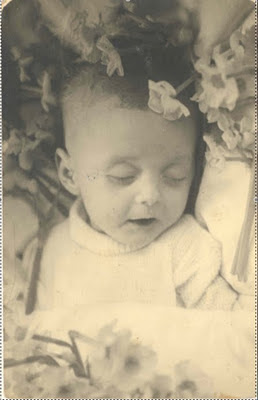
‘I could not believe she was dead,’ my mother said. ‘I ran to my neighbours. I could not believe it and even later when I walked all the way back home to Haarlem with an empty pram, I could not believe she was gone.’ My mother folded her hands in her lap.
‘But I did not have it so bad,’ she said. ‘There were others much worse off than me.’
My mother was on a roll and I did not want to interrupt the flow of her words.
‘There was a fourteen year old girl in our parish. Her father had made her pregnant. Can you imagine? Horrible. He had run off. He had run off because it was against the law. That poor girl. I thought of her and what happened to me seemed not so bad.’
My mother’s eyes stared ahead into space as if she were scrolling through a movie of her memories. I said nothing, but pennies were dropping.
‘I thought too about that girl’s mother,’ my mother said. How could that mother live with herself?’
My mother asked this question but she did not seem to want an answer, or even a response.
I sat there dumbfounded, with one thought only:
That mother is you. That mother about whom you wonder is you. And that fourteen year old is your other daughter.
Can’t you see the connection?