I woke this morning to an ear worm in my head, an ear worm from the German ohrwurm, a song that keeps on repeating itself however much I might try to stop the soundtrack.
It’s faded now but I dare not repeat the words of this song here for fear it will return like a recurring night mare. It’s relentless.
I had fully intended to go to an Al-Anon meeting this week, a meeting devised for the children, friends and partners of alcoholics, not to deal with any present concerns of mine but to deal with the past.
It might seem a strange thing to do but I have started to write about my childhood memories of going to an Alateen meeting with several of my sisters and brothers but the memories are so vague and disjointed that to write about them would essentially be to make them up.
Wouldn’t it be better, I thought, to see what such a meeting is like today?
When I mentioned this idea to my daughters they were horrified. How would the other people at the meeting feel? My daughters’ misgivings sowed seeds of doubt into my own head. I might be seen as an intruder.
‘What are you going to say to them,’ one of my daughters asked, ‘when it comes to telling your story? Are you going to say my father, who’s been dead now for almost thirty years, was an alcoholic?’
I had thought I might say just that but I could not say I’ve come here today because I want to write about this experience, embedded in the experience of my past. So for the moment I have shelved the idea.
I have another idea for a piece of writing percolating in the back of my mind, but this one I shall keep to myself for a while, in part because I will only know about it more fully when I write it, and partly because, as with the Al-Anon plan I described above, I fear too early exposure will ruin it.
Does this happen to you? You have an idea in your mind. It feels full, rich and ready to be explored. You feel excited and effervescent with the energy of it but as soon as you start putting it into place it collapses like a house of cards.
I am riddled with the disappointment of such failed ideas, like dreams that are with me first thing in the morning still pulsing with energy only to be gone completely by mid morning.
I wish I could say the same for my ear worm. It’s still echoing there in the back of my head and I refuse to invite it into the forefront because it will once again persecute me and not let me be.
I had thought I could write the words of my earworm here and sort of evacuate them onto the page, but that might then send the ear worm off into your head, such things can be contagious, though only the words written on the page might not have enough of an effect to send them over to you. No, you’d need the music as well. So be grateful you’re spared.
I visited a blog for the first time yesterday that I think is worth a mention here. I don’t usually mention other people’s blogs – there are so many wonderful blogs out – there but this one caught my attention because of the visual element, and also because, as I said in one of my comments to Richard at Eyelight about his post Do I know you?, he has done something similar to what I believe Tracy Emin tried to do in her exhibit all those years ago with her My Bed.
The exhibit caused quite a stir at the time as I recall. How could anyone call an unmade bed art? Only when I read a more detailed account of Tracy Emin’s exhibit in a paper that likened autobiography to the ‘rumpled bed’ did I realise the extent of this work as a piece of self-portraiture and something many of us bloggers today attempt to do with our descriptions of the bric-a-brac of our lives, our small snap shots and vivid details both of the past and present that in themselves are like rumpled beds – if I dare to use the bed you sleep in as an analogy for a life. The entire bedroom is perhaps better.
The other day I found a photograph of my mother in her bedroom some fifty years ago. In it my mother poses in front of her Queen Anne mirror which has long fascinated me. Sometimes when my parents were away, I stood in front of this dresser and folded the mirrored arms around me. When I looked either to my right or to my left, I could see my image repeated again and again, ever decreasing in size, on and on into infinity. I could see my back and my front multiplied, and when I turned to the side, I could see my many profiles.
My mother in the photograph is one thing and I will write about that in the fullness of time but it was the rest of the room that soon caught my eye: the unmade bed, the clothes piled high on the chairs on either side, the cluttered bench below the mirror.
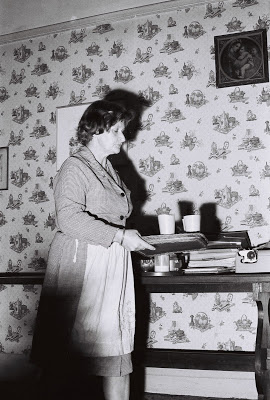
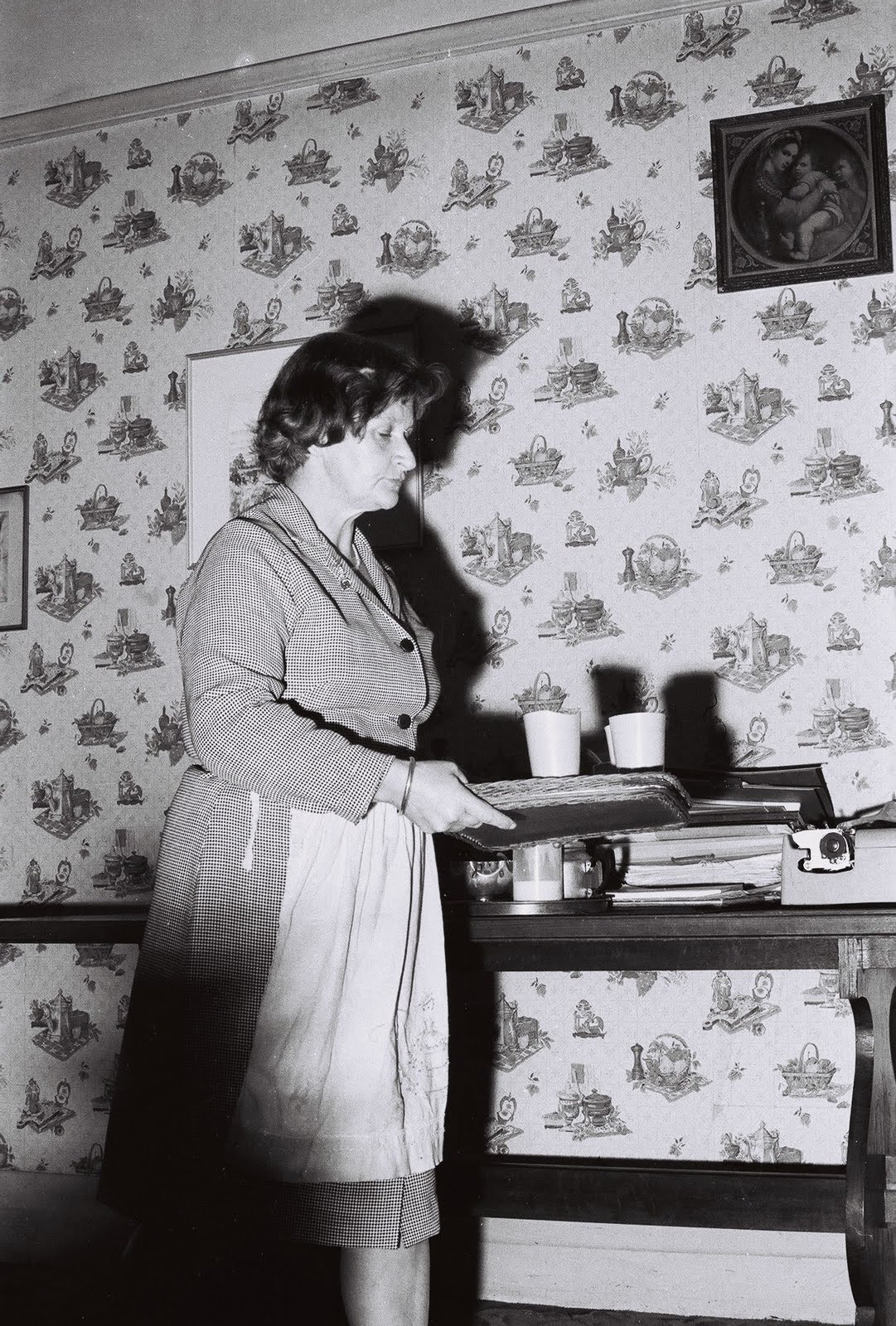
Not to confuse you, here’s a picture of my mother in our lounge room. Note the amazing wall paper. My mother in her bedroom is not yet ready for publication.
I tend to divide houses into three types: those which could feature in a copy of Vogue Living, those which are cluttered and lived in to the full, and finally those that are squalid. I imagine there are multiple variations in between.
My house today is of the cluttered variety and I see and remember from this photo that so too was my mother’s house, the house of my childhood, which I thought then bordered on the squalid. It was probably not so.
My brother tells a story of visiting a friend when he was still in primacy school. My brother did not want to take off his shoes for fear they might stick to the floor, and later, at breakfast he found a sock in the vegemite jar.
The sock in the Vegemite jar has come to represent in my family the epitome of squalor. We joke about it when things are grim in terms of the untidiness of our household.
When we can find a sock in the vegemite jar, we will know that we have sunk to a new low.
There’s a cat in the back ground clamouring to be let inside my daughter’s bedroom where she is now trying to sleep and therefore refuses to get out of bed to let the cat in. My daughter is happy for the cat to join her, but not to have to get out of bed to let her in, so I must do so.
Otherwise, the echo of the cat’s caterwauling might hit off another echo, the ever present earworm, and my head will be so full that I won’t be able to proof read the reformatted draft of my thesis, which is my next task for today.