
‘Women’s suffering is so normalised that people call it “drama” instead of “damage” …For generations Women’s suffering has been minimalised, re-written and weaponised. Bruises become “over reaction”. Trauma becomes “attention seeking”. Borders become “attitude” But naming it matters.’ Zadie Smith
The older I get the more I try to imagine myself in my mother’s mind. The things that made her tick. Not just her words and actions, but her inner workings, hidden from view but cloaked in religious philosophising and doctrine that served as a lock on her innermost qualities such she herself might not have known much about what went on inside of her.
Psychological insight was not high on her agenda of good qualities. Religious dedication and adherence to the word of God was.
As a therapist it seems a significant thing to do. Interrogate our relationship with our parents, especially our mothers as the first port of call to human connection.
I worried for the birds in the extreme heat. On the last day of extreme heat, I found three magpies in my back yard near the outside table squawking, the young one, the one with grey flecked feathers and slightly smaller than the black and white birds I assumed were parents. I offered them water in a low lidded bowl on the table and moved away.
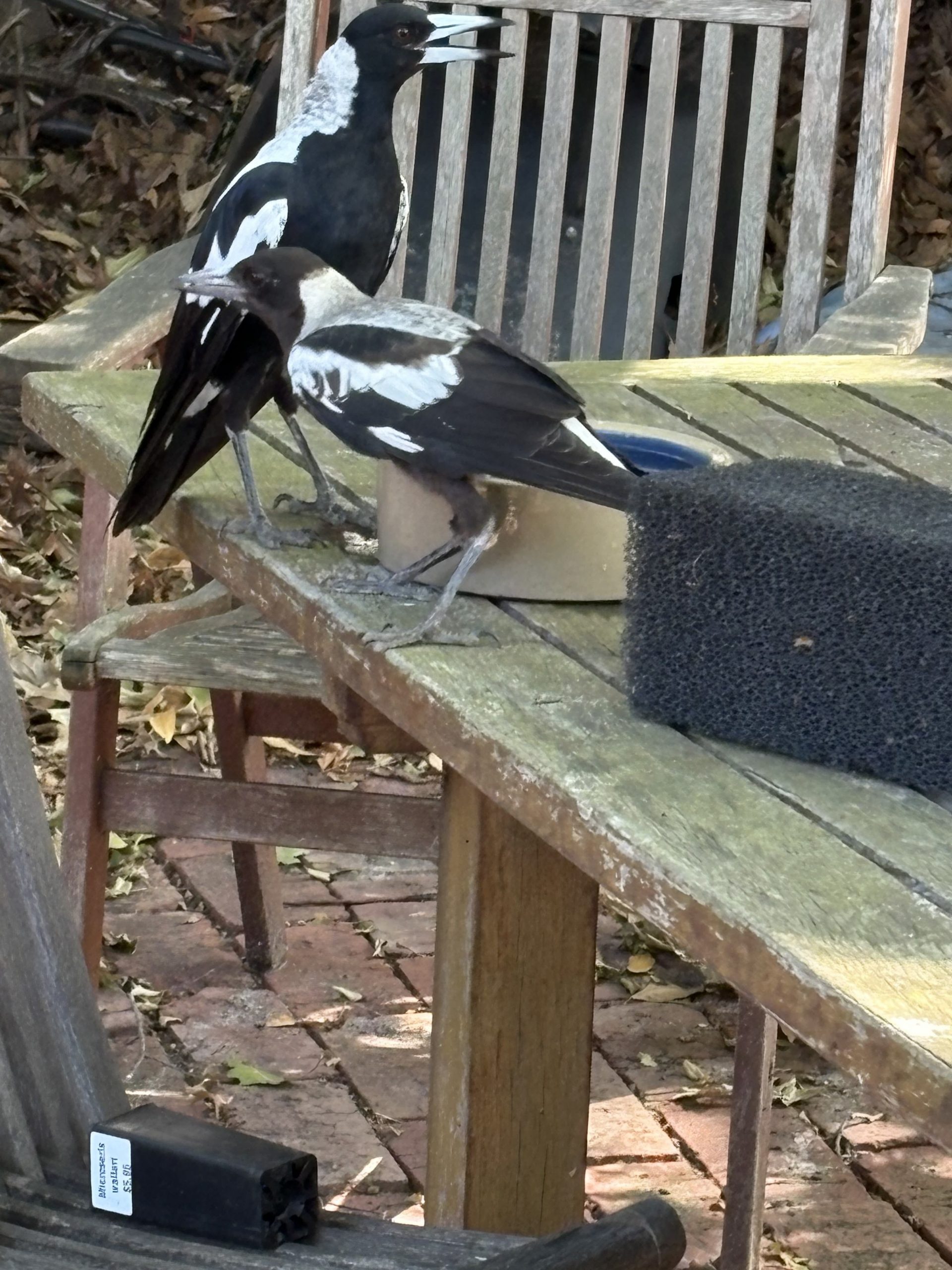
The little one was the first to drink.
Magpies are familial creatures I understand, and they have the capacity to remember those who are helpful and those not. Last night over dinner my husband aimed to leave the few scraps of our meal, potato, carrot and some cooked fish on the table as an offering.
I once worried about magpies in the spring. Hanging out washing I feared they might swoop, particularly after bulldozers had moved into their territories nearby and mowed down trees to make way for a retirement complex. To make way for the rich elderly in my community. This is one of those super-duper complexes that looks like a hotel with downstairs dining rather than a home.
‘We think back through our mothers if we are women,’ Writes Michelle de Kretser in her book Theory and Practice.
Her mother in the book comes across as demanding but concerned. With high expectations for her daughter. Academic achievement and a good husband. As if such can co-exist.
When my first-born daughter was sixteen years old she took part in a Rotary public speaking event in which she talked eloquently about her take on feminism.
She was convinced then she could have it all. Motherhood and career and in some way thirty years later she has it all, in terms of academic achievement, career and family but at what cost?
It is never easy to manage the two, career and mothering. The two roles scream at one another. You should be doing more.
When she was around the age I am now, my mother wrote her autobiography. I’ve read it twice now and each time I can hear her voice through the editorial offerings from one of my sisters-in -law who tidied up some of the grammar.
My mother writes well but she surprises me in her limited understanding of events. As she once told me when I was beginning my writing career, ‘don’t write the grotty bits’.
In response to a paper I published on childhood abuse when the editor of the collection described my story in the back blurb as one of ‘horror’, my mother questioned this choice of words.
She did not like to think of childhood sexual abuse as horror.
What could he have been thinking?
My mother admired her father, my Opa. She was his first born and a daughter ahead of four sons before a second daughter was born as one of twins followed by yet another boy.
My mother saw herself as both princess and housemaid for the family. Her mother who had once been a teacher married my grandfather late for the period in her mid-thirties and seven children followed in close succession.
It must have been tough. She had the help of a maid and woman who my mother referred to as char lady. The women who did the heavy cleaning.
The irony then, in her fifties my mother took on a cleaning job at the convent attached to my school in a bid to earn extra money to help support her large family of none.
My father earned good money as an accountant, but he drank heavily and was not good at sharing his earnings. She often had no money in her purse to manage the small extras we needed as a burgeoning family.
When I was young my parents kept accounts at the various shops near our home, the milk bar, grocers, green grocers and stationers. The chemist. Everywhere my mother shopped locally offered credit, but when the bills came in at the end of each month there was darkness and fury as my father needed to cover the expenses. He saw no need to offer my mother anything extra to put in her purse. We cost him so much money just to love.
My mother was desperate to pay the modest school fees required at our Catholic convents for girls and colleges for the boys, but there was never enough left over. Hence her decision to work to pay the school fees.
Her valuing of education is one of the things I appreciate about my mother, and my father, too. Maybe it’s typical of migrants. They see the only way ahead through education. To get ahead in the world. They encouraged us with our studies in a way my husband’s family did not.
Last night he told me the story of his arrival at secondary school when he first picked up his algebraic textbook, and learned that A plus B equals C. It dawned on him at this moment that A and B could be of any value you chose, and they would then determine the outcome of C together. C depended on A plus B.
This was a revelation to a small boy of twelve so much so he went home and told his mother the good news.
‘It’s all gibberish,’ she scoffed as if to say, rot and nonsense. Don’t waste your time here. In much the same way she once burned his books for their salacious content.
My husband calls it bog Irish Catholicism. Unlike my mother, who read her bible in childhood and studied it closely in her later years. ‘The Irish don’t read the bible,’ my husband said. ‘They just do as the priest and bishops tell them. They don’t have minds of their own.’
Many an Irish person might challenge this and I think back to the great writers of our time and before, to James Joyce and today’s Colm Toibin and Niall Williams among others. And the women, Anne Enight, Clare Keegan, Maeve Binchy. All those wonderful writers whose lyrics spring from the page like music.
And as ever my mind wanders all over my life and as far as I am in awe of the breadth of my experience I still find it hard to reign in my thoughts.
To think back to women’s suffering where I began and shift to the suffering of humankind, but I’m in danger of doing the very thing I rail against: the minimisation of what it’s like to be a woman, today and in the past. As distinct from the struggles men might encounter.
This polarisation which makes it even harder to think about the way that like equations A and B equals C, even if A has a high value and B a low value, they even out at C.
Imagine what might be the score if they were of equal value. If we rated all genders as worthy of respect, and here I include the entire LGBTQIA+ community. And this is not to minimise the suffering of women because I suspect these things all piggyback on one another.