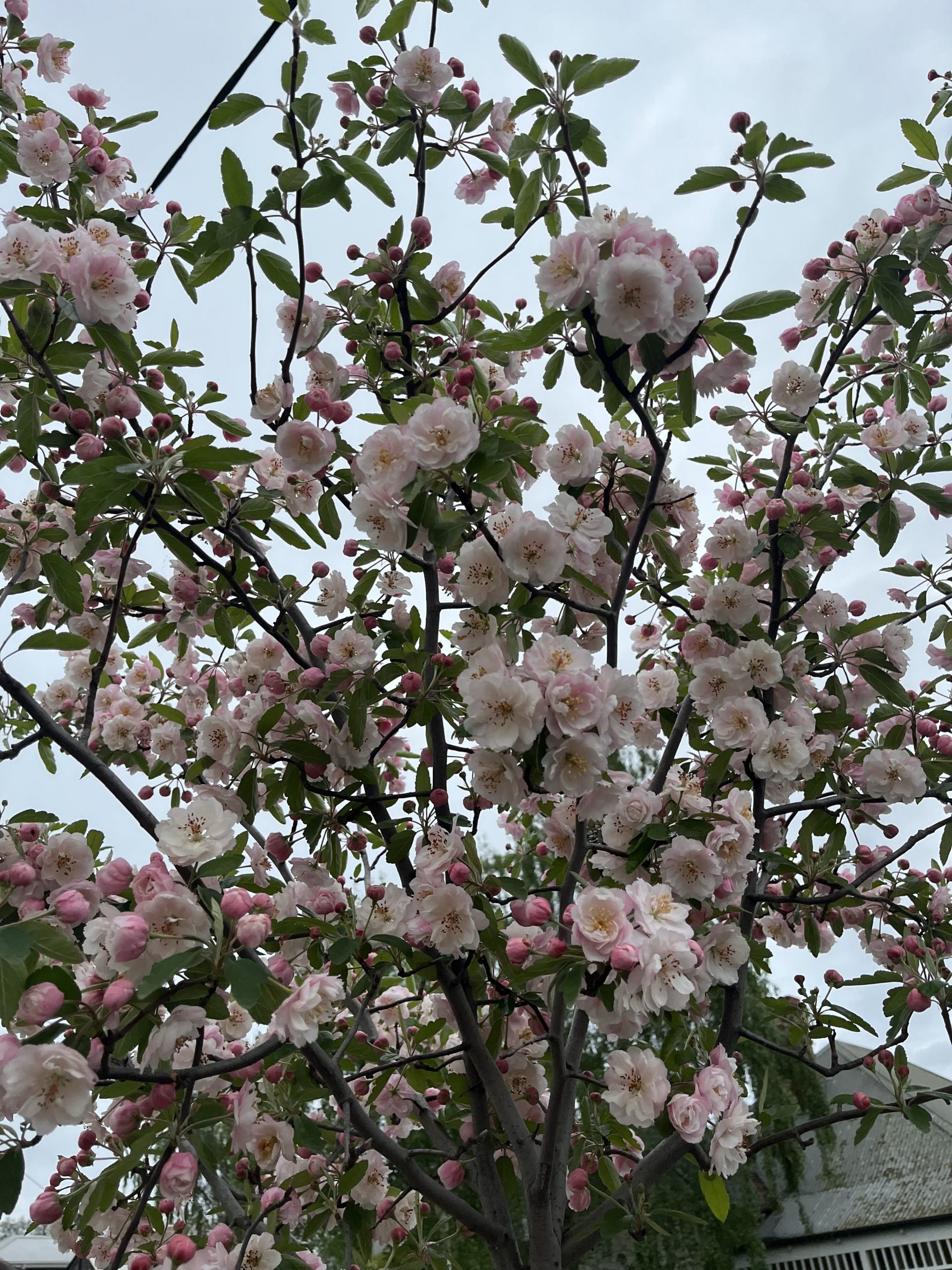
We layer the present on the past.
As Ann Patchett writes through her character Maeve in The Dutch House, ‘I see the past as it was, but we overlay the present onto the past. We look back through the lens of what we know now, so we’re not seeing it as the people we were, we’re seeing it as the people we were. And that means the past has been radically altered.’
Reading an essay on the significance of laundry in our lives I’m pitched back to a time my sister and I boarded with a Dutch family on top of a hill on Pleasant Road in Camberwell.
I was fifteen years old, and painfully self-conscious. The ugliness of my adolescence hit me with a vengeance, complete with pimples and weight gain. My teeth were yellowing, and I covered my mouth so people might not see.
The Dutch family with whom we stayed, headed up by the formidable Mrs F, her face as wide as a plate, her hair wispy blond grey in curls around her ears, tall and angular from what might have been arthritis in her gnarled joints, spoke with the familiar accent of the Dutch, but with an added bass that gave her authority over and above her husband who seemed dwarfed by comparison. He was a mild-mannered accountant who wore dark spectacles and reminded me of kind uncles on my mother’s side. Only he seemed more downtrodden.
All of this I describe in retrospect.
At the time I formed almost no opinion about this family other than to fall in love with the third eldest boy who had blue eyes as deep as oceans and was studying medicine.
By contrast, I disliked the youngest boy in the family who was a year ahead of me and maintained his sanity in this large Catholic family by insisting on living in the backyard in the family caravan. At the time this seemed reasonable, but looking back, I marvel that Mrs F could tolerate it.
This family now related to me by marriage, but that’s a whole other story, has melded into my memory like characters from a fairy take.
The house quaint in the manner of Dutch houses in my imagination with high pitched roof, double story, tiny rooms with low ceilings and a spinning wheel just near the front door. An ornament I never saw in use, it threw the house back to a previous century.
My sister and I shared a double bed at the top of the stairs, a bed replete with white bedstead cover and cosy sheets. So white it troubled me to sleep there. And the agony of the blood when my sister unexpectedly copped her first period while sitting on the edge of the bed in conversation with one of those brothers. Oh, the mortification
Reading an essay on laundry I found myself thinking on Beatrice Potter’s Mrs Tiggy-Winkel, the delightful hedgehog laundry woman who takes in the washing of the local animals and finds little Lucie’s lost kerchiefs and pinafore. ‘Lily white and clean oh’, she sings as she struggles with a rust spot, reminding me of the blood we tried to remove from Mrs F’s white bedspread, never once thinking we could tell her.
She disapproved, I discovered later, of our habit of washing our underwear each night and hanging it to dry at the end of the bed. We did this for two reasons. One, we had only three or four pairs of underpants and socks and could not leave them in laundry for too long, and secondly, because they had seen better days.
We were ashamed in every facet of our lives. Ashamed to be living with this seemingly well-heeled and ordinary good Catholic family while ours had fallen apart and the sense, which again comes to me only in retrospect, that Mrs F had wanted to take on two new daughters to help her around the house.
She had five sons and only one daughter, her youngest, far younger than us and of little use in cooking and cleaning. I did not understand this at the time and although we might have offered to help with the washing up after dinner, we did little else to help Mrs F with her household chores such she resented us.
This was a time when I decided I should concentrate on my schoolwork if I was to get anywhere in my life. Most days I went down the road to Anderson Park several blocks away and sat on a swing trying to learn my Latin declensions and French vocab. Determined to impress the nuns with my intellect.
It felt forced and came to me only through rote. I could not understand much of what we Iearned at school other than to cram it all in. Languages were okay but numbers defied me.
Numbers on a page swam in front of my eyes like pea soup and I was relieved to finally escape them as a compulsory subject.

In the park this day I struggled with the verbs ‘to be’ and ‘to have’, both in French and in Latin, to get the tenses right, to understand those aspects of Latin, the vocative, dative, generative and ablative.
These words still in my head and still as elusive even as I went on to study Latin at university. Only through rote learning can you study at such a high level and still not understand?
I missed the foundations, locked inside a bubble of tortured feelings, including on this day ,my erupting passions for the third son. He had invited me and my sister to open our mouths so he could study our tongues, throats and teeth for his medical studies.
My sister, unashamed of her teeth obliged, but I high tailed it out of the room and down to the park, flushed with shame. I could not let him see inside my mouth for fear of what he’d find. The crumbling back molars over which I rode my tongue. My mouth was like a decaying city.
For this reason, I was relieved my mother could not afford the dentist. I could hide even more once the dental hospital would no longer take our family under its roof because my father earned too much money.
We were stymied. And I was glad, even as a big part of me know my teeth needed attention.
Shame makes you want to hide. Shame leaves you cowering behind your books.
Picture me a gawky young girl, long lank hair pulled into pig tails, a splotchy face and grubby uniform, seated on a swing trying to divide her thoughts between the blue eyes of Mrs F’s third son and French words for the everyday, the birds, the clouds, the grass. Rote learning a poem by Baudrillard. Une grenouille vit un boeuf qui lui sembla de belle taille.
Writing it here I can still hear the words in my head but I cannot remember their exact spelling or order. The story of a frog who wanted to be as big as a cow, so he blew himself up until he exploded.
Very apt for my state of mind that day, only I could not inflate myself. So deflated, I could only go home to Mrs F’s house and hide.