‘Shop as you please. Pay as you leave.’
The sign floated on chains above laden trays in the Coles Variety store. In 1962 it was a shopper’s paradise anchored at the foot of Burke Road in Camberwell where the Priceline store sits today.
To shop is to write. To make choices about which purchases you select from the myriad of items on display and the Coles of my childhood was ideal. Nothing cost over two pounds six. That’s about five dollars in today’s lingo.
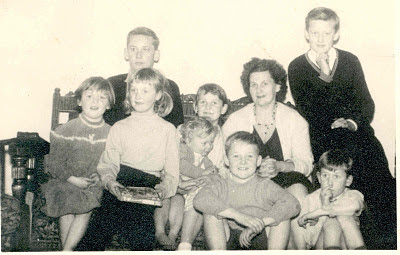
One Christmas, my father gave me and my sister the equivalent of ten dollars from which we were to buy every member of our family of eleven a present. I was ten years old, the age of calculation, of making sense of things, of words, the way they fitted into sentences, the way things on display cost various amounts according to their value.
In those days I did not consider the value so much as the cost and given I had only a limited amount from which to buy, along with my limited vocabulary, I focussed on the price. For my oldest brother, I chose a pair of nail scissors, whether or not he needed them. A magnifying glass held in red plastic for the next brother down. A yellow sun hat for my older sister, who already had plenty of hats at her disposal.
We did not buy for me and my younger sister, both agreeing we could do without. We wanted only to buy for the others. For our two younger brothers we bought a notebook, for the one who loved to write, and a fish net for our nature boy. A long handled plastic rattle for the baby, and porcelain egg cup for my toddler sister. For my mother, a Mantilla in black lace to wear to Mass, even though her old one was still serviceable and for our father, a map of Melbourne.
The delight of shopping, of calculating which items to choose and how to eke out money was nothing compared to the joy of wrapping these gifts in paper, cheap wrapping paper, my mother bought in sheets from the newsagency, then putting them under the tree.
To wrap in paper like wrapping images and ideas with words requires choice, care, and a certain ability with scissors and sticky tape.

I was too young then to appreciate the sardonic looks from my older brothers who were measured in their appreciation, but the instant ecstasy from the little ones was palpable. Either way, the response did not matter so much as the process of getting there, the process of giving, like the process of writing.
It’s of little consequence if we experience limited or no emotion as we write. It’s a ‘continuous thread of revelation’ Eudora Welty argues. We writers are like small children threading beads on a string. We select one coloured bead after another and thread it onto our line. We form patterns, haphazard or neat. The reds first, the blues then greens, followed by yellows in blocks of three, then repeat again. Or something more random, a red here, a green there, then two blues, a yellow and a green, two reds, a green, to form a fractured rainbow. Convinced what comes out in the end will be a work of beauty, one we might wear on our wrists or round our necks with pleasure. Or in disappointment.
Creativity is one such process. One in which the artist, the writer, the poet conceives an idea in their head, which is utterly compelling. They set down to write or paint and as the paint spreads across the canvas, one splash after another, or the words on the page a jumble, artists find themselves increasingly sad.
This is not as they had imagined their work might look. All joy has leaked out of the project and the artist is faced with a choice. To chuck out the canvas and begin again, to give up altogether, or to stay with the beginnings of whatever they have revealed and work on it.
The artist dabs on more paint, the writer reshapes their words. No longer from a position of heightened joy and expectation. No longer wracked by a desire to bring that internal creation onto the canvas or page, but from a desire to reveal anew. This is the creative element. The essence of never giving up.
The Australian artist Grace Cossington Smith once talked of this need. As Drusilla Modjeska describes it:
‘A continual try,’ [the artist] said. It’s true of painting, it’s true of writing, and it’s true of life. The process of staying with that continual try can produce long low loops and sudden illuminations, which we see in retrospect as springing open and banging closed. But in the tug and pull of time it is another day lived, another piece of board on the easel, another squeeze from the tube.
It takes time. And a willingness to suspend judgement. And bear frustration.
I look back on my ten-year-old self blinded by my wish to give, restricted by my lack of funds and discernment. As I grew older I wanted to give more but always within the limitations of what was possible and what others might appreciate. The same is true of writing. We write to enthral our readers, to stir their hearts to tackle the reader in ourselves who makes demands on us to understand whatever we might be battling inside.
Ann Patchett, when asked about her sense of achievement after completing another book, told her audience this was not the book she had wanted to write. The book she wanted to write could never be written. It lay there in her imagination, an impossibility. This was the closest she could come to the story, and she could not offer more.
We are all constrained by what we have inside. A ten-shilling note to spend at Christmas on nine people in Coles during the mid 1960s could only take you so far. The meanderings of your mind, your fingers on the keyboard. Then again we can also revisit and tackle a second, even third or more tries to write something better, much as we might never reach the standards of our creative desires.