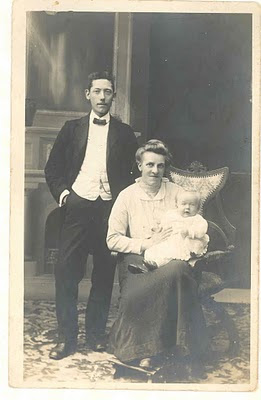
My mother told me one day about her father and what a good man he was. She told me how he worked as a physical education instructor at the Lyceum in Haarlem when she was young; that he was fit, and could have done almost anything to which he turned his body.
My mother’s grandfather, like her father, was also a good man. He had gone to Italy as a soldier to fight for the Pope. She had a photo of him in uniform.
All of her family were like this, she told me, all of them good men.
I sat with her at the kitchen table one day, my eyes fixed on an empty cotton reel I had rescued from her sewing basket.
One of my brothers had helped me to nail four thin nails into the top of this cotton reel around the hole and my big sister taught me how to cast stitches in coloured wool, pinched from my mother’s darning supply onto the nails.
I used a long thicker nail, like a crotchet hook to force each strand of wool over the four nails one at a time.
After I had gone through the four nails with wool several times over, I could just see the line of wool peek out from the lower hole of the reel. I pulled at it and gradually out came a thick plaited coil of knitting.
I knitted for hours like this and in time had a long snake of knitting that I could coil around itself to form a miniature rug for my dolls.
Or if I was clever I could turn it into a hat or if I was not so clever I could use it as a toy scarf. It was too thin to use as a scarf for me. Besides I did not like scarves. They itched my neck.
My mother stood at the stove stirring a pot full of split peas. She had put them on hours earlier in the day and filled the pot with litres of water, enough to feed all of us from the thick pea soup that smelled of the bacon bone she had bought from Mr Brockhoff the grocer’s the day before.
The bone was brown and ugly and all dried out before she dropped it into the pan but by the time it had cooked in with the peas for several hours, swathes of pink meat crumbled off and she picked at them with a fork and pulled them off the bone. She lifted the meat out and then chopped the chunks into smaller pieces so that all of us could have some bacon in our soup. Otherwise only one or two of the lucky ones would get meat.
My mother told me this was important. It was important to share things equally. It was important to make sure that everyone had enough. Her father had taught her this, she said.
I watched as she cut the bacon into diced pieces and hurled them back into the pot and stirred some more.
Her father, the physical education instructor, had treated all his students well, my mother told me and she knew this for sure because after she had grown up and become a teacher herself, at least a sort of teacher – she became a cub mistress with the scouts in her town – some of the children who were in her care and their parents told her about what a good man her father was.
He worked for the St Vincent de Paul Society on the weekends and one day my mother told me he heard about a young girl who had become pregnant when she was only thirteen years old. The girl’s father was the baby’s father, my mother said and every one was shocked.
This girl who was about to give birth to her father’s baby and had no clothes for the baby. And so my mother’s father asked her to collect as many baby clothes as he could spare, pack them in brown paper and take them around to the house where the young girl lived.
He did not want to go himself. He was a father, too, and fearful that if he saw the young girl’s father that he might want to hurt him. Father’s don’t do things like that to their children, my mother told me.
My mother took the package to the house, five streets away from her home on the Marnixplein and knocked at the door. The house was not in good shape. It needed paint and there were roof tiles askew and fence panels missing.
It was as if the house fitted in with my mother’s idea of this young girl who was also not in good shape.
My mother knocked at the door again and still no one answered. She waited a while for someone to come, but like her father she was frightened, too, of what she might find.
Unlike her father, who told her that he might do damage, my mother told me that she was frightened that she might get damaged. That the girl’s father might turn on her.
‘Why didn’t anyone call the police?’ I asked my mother.
I could have asked my mother. I should have asked my mother from another position, that of now.
But nine year old me, who pulled at the thread at the base of her empty used up reel and longed for the woollen coil to grow thick and productive, could only wonder about the good and bad men in my mother’s life.