Because I’m freezing

My youngest daughter is learning to drive. In these first few weeks she is having proper lessons with an RACV driving instructor before she is ready to go out and practice with her parents.
‘The instructor is so strict,’ she said to me the other day as I drove her to school. ‘I so much as creep off the white line a fraction and he orders me back.’ She turns towards me. ‘You don’t always stay on the white line.’

‘I know, ‘ I said. ‘But it’s like learning the rules of grammar. You need to be meticulous when you first learn them and follow the rules to the letter. Only when you understand them can you deviate.’

Learning the rules of the road are more essential to the preservation of life than learning the rules of grammar but I suspect there is merit in first learning to do something – whatever it is – strictly, according to some set of rules and then using your intuition to know when to break them.

Tomorrow is the anniversary of the day I broke my leg last year, 4 September 2010. I must take care to avoid a repeat. Lightning, they say, never strikes in the same place twice. It’s unlikely I’ll break my leg again, but why, I wonder, is it such a time of anxiety?

Twenty years ago almost to the day, on 2 September 1991, the analysts gave me the sack from the psychoanalytic training. I do not write about this event in my blog as it seems too unacceptable to mention in such a public forum, besides it belongs to a part of my life I do not include here, my professional life. And yet it is an event that also sparked the writing of my thesis on the desire for revenge and so it is an essential brick in the wall of my story.

It’s funny how blogs represent only parts of our lives and other parts remain hidden from view. Mostly I hide the things of which I feel most deeply ashamed. Even as they peek out at me and beg to be included in my writing. Until I can move a little past the initial gut wrenching tug of shame I cannot speak about them. I must hide them from view. So it is with the analytic training.

Twenty years is a long time to feel so deeply about an unfortunate event and although I do not write in detail here about this experience, you can take my word for it, this rates for me as one of the worst experiences of my adult life.

Though of course, like so many traumatic experiences it has proved itself to be one of the most useful. It stimulated me to go back to writing, an activity I had abandoned once I hit adolescence, when I first decided on a career in the helping professions.

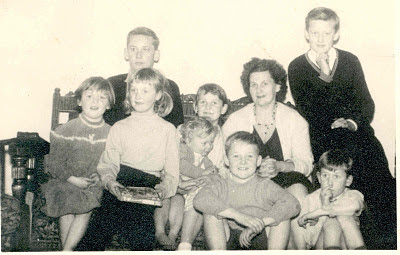
Here I shall include an image of my father circa 1964. I include it as a cryptic reference to my father who had an influence on the experiences to which I allude here and also to break up the text. I’m trying hard to respect people’s abhorrence within the the blogosphere for reams of writing.

There are two stories that come to mind here. The first I heard on the TV series Ballykissangel, when the priest, Peter Clifford, first acknowledges his love for Assumpta Fitzgerald

There’s this baby polar bear swimming in the sea and he climbs out, runs across the ice to his mother and says, ‘Mum, are you sure I’m a polar bear?’ And his Mum says. ‘Don’t be daft. Of course I’m sure. You have white fur, you eat fish. You’re a polar bear. Now get back into the sea.’

But the little polar bear is not satisfied. He jumps out again and goes up to his father and says, ‘Dad, am I really a polar bear?’ And his father’s says ‘What are you talking about? Of course you’re a polar bear. You’ve got white fur, you eat fish, you’re a polar bear. Why do you ask?

And the baby bear says, ‘Because I’m freezing.’

This story has stayed with me, as a statement of the pain of not belonging, a fish out of water, to use an ill chosen cliché.

The second anecdote derives from a you tube I saw by chance recently on the nature of creativity through Hilary’s blog. To be truly creative the photographer, Andrew Zuckerman, argues you need ‘curiosity and rigour’. He uses the example of an experiment he’d heard about where researches used three groups of mice under three different sets of conditions.

The first mouse had everything it needed in the cage, and nothing was required of it to meet its needs. A sort of mouse heaven. The second mouse also had everything it needed, but in order to get to it, the second mouse had to go through a simple series of routine tasks. The third mouse had everything it needed but to get to it this mouse had to leave its cage and go through an elaborate series of contraptions including a high ledge along which it needed to walk suspended above a tub of water before this third mouse could get what it needed or wanted.

Then the researchers measured the brain development of the mice. They found the first mouse showed no dendritic growth at all. Nothing in its brain changed during the research period. The second mouse grew new dendrites, but it was the third mouse which not only grew more dendrites but also grew connections between them. The point being that to grow we need to face our fears and challenges.

The first story suggests a wish to get out of what to the baby polar bear felt like an overwhelming challenge, to belong where he felt he did not belong, whereas the second one urges us to press on regardless. There is an optimal level of challenges we must face. too much challenge and we buckle under, not enough and we atrophy.

Yesterday was the twentieth anniversary of the day on which I was dismissed from the psychoanalytic training and I did not even recognise it at the time, though I left my keys behind in the changing rooms of a clothes shop where I had tried on a shirt for size and I misplaced my credit card after I bought the shirt and could not find it later in the evening when I was out for dinner with my husband and went to pay for our meal.

I knew then, as we walked home from the restaurant and I had still not located my credit card that something was not quite right.

Not until now this morning, after I have relocated my credit card in another section of my wallet where I usually only put coins and notes not cards, do I realise how unsettled I am. And tomorrow – and this I remember in advance – is the second anniversary of my broken leg. All up a time of painful memories and anniversaries. I must take extra care today and tomorrow.

I haven’t read the book, but in my opinion, it’s not worth reading.

It’s within a week of a year since I broke my leg. At the time recovering from this break seemed interminable. Eight weeks of my life weighed down with a cast from ankle to knee and now I can scarcely even remember that it happened. I no longer even notice the twinges that beset me earlier this year when I was still recovering.

My broken leg has healed and now all I have is the memory and the cast which I could not bring myself to chuck out. For one thing it cost over $900.00 – would you believe? – and for another, it seems sacrilegious to chuck it out. But it’s of no use and when I dragged it out the other day to show my brother-in-law who lives interstate and missed out on the drama of my broken leg, I realised that it could not serve as the basis of any work of art – an earlier fantasy of mine.

The cast was custom made to fit my leg. It has no place in my life anymore, not unless I were to break my leg again in the same place, and that is unlikely. In the next clean up, which I plan to go through over the Christmas holidays I may bite the bullet and consign it to the tip.

I have a chapter in my thesis in which I discuss the furore that erupted over Ann Patchett’s book, Truth and Beauty. The book is her memorial, you might say, to her friend Lucy Grealy, author of the renowned Autobiography of a Face. Grealy died in her early forties of a suspected heroin overdose.

To me both books are beautifully written and well worth reading, but the reason I focus on them in my thesis has more to do with the audience response to these books, particularly as I see them played out within the blogosphere.

There is a post dedicated to discussions of a letter that Suellen Grealy, Lucy’s older sister, wrote to The Guardian about Patchett’s book.

Suellen believes that Ann Patchett has ‘hijacked’ her family’s grief by writing about her younger sister and to some extent about the Grealy family as she has. Mind you, there is not much about Lucy Grealy’s family in Patchett’s book as far as I can see. The book is more about Lucy herself and her relationship with Ann Patchett.

The thing that intrigues me is the degree to which this book has inspired a line of hate mail directed against Patchett for daring to violate the Grealy family’s right to its private grief, or at least for daring to present a different image of Lucy Grealy to the one she presented in her autobiography.

I’m interested in notions of grief, particularly in so far as they relate to issues of privacy and the public sphere. I understand Ann Patchett’s book to be in part her attempt to come to terms with the loss of her beloved friend and a commemoration of their friendship, but also as an expression of, or a space in which to explore, some of Patchett’s anger with her friend for perhaps not making a better fist of things.

Having said that, I don’t sense that Ann Patchett lacks in empathy for her friend, Lucy, whose life sounds as though it was horrendous. There’s something though in the way we live our lives, the uses to which we put our lives, especially when those lives are described in public as in the writing of these two books that then invite others to come along and judge those lives, for good or for ill.

To me there’s a confusion between the content of the writing, the writing itself and the real lives of the people, either those who write or those written about.

In one of the comments on this blog discussing Suellen’s letter of protest, Jack Grealy, a nephew, writes a comment in which he complains about what he considers to be one blog commenter’s attack on his aunt, Suellen. ‘She’s my aunt,’ he seems to say. ‘You can’t talk about her like that.’

But in the public sphere, in the blog world, Suellen Grealy is not simply Jack Grealy’s aunt, she has become a commodity of sorts, a character in a novel.

She has written about her perceptions in her letter to The Guardian and has thereby thrown herself into the mix, her sister Lucy’s book about her own life, and Ann Patchett’s response to that life and in so doing, she has become a source of interest and curiosity for readers throughout the blogosphere. Therefore another commenter, tells Jack Grealy that he’s out of line.

Although Patchett’s book came out in 2004, and Grealy’s ten years earlier, comments still arrive at the blogsite that posted Suellen’s letter from The Guardian.

Lucy is dead, Ann Patchett has gone on to write several more successful novels, and heaven knows what Suellen is up to these days, but the saga continues.

I find extraordinary the extent to which people feel free to comment on this fracas, including those who admit to not having read either book.

They wade in on the fight as if a mob is gathering on the street and people are baying for someone’s blood – any one’s blood it seems, though not Lucy Grealy’s. She’s seen as the true victim, but her friend, Ann Patchett, is fair game for daring to write about Lucy as she has done, or likewise Lucy’s sister, Suellen, for daring to take Patchett to task.

I suppose literary skirmishes are not uncommon. They bring out the worst and the best in us. It is for this reason, too, I think there is some merit to the notion that even the best of writing can disturb and evoke a hostile reader response.

What is it that happens to us when we read? Is there some sense that when we take in the words off the page they become our own and therefore we have the right to judge, not only the standard of the writing, but also the content. It is as if we become both judge and jury, not only of the writer but also of those who are written about.

It is a powerful phenomenon and it’s one reason why I remind myself constantly that writing is a dangerous business. There is a world of potential critics out there ready to berate you for writing things they may not have read, or they may not want to read, or see, or hear, or remember, or for writing in such a way as to stir up emotions in readers for which they have no other outlet than rage directed at the writer, who is only the messenger after all.

Somehow unlike the cast from my broken leg, certain published writings can never be consigned to the tip. They go on being worn, even after the leg has healed.