On childhood abuse

It’s ‘impossible to explain to the healthy the logic of the sick.’ Hanya Yanagihara

So we understand from Jude St Francis, a man in his mid-thirties crippled with a disabled spine following a serious car accident in which he nearly lost his life. But that’s not the half of it in his Little Life, along with that of his three close friends, JB, Malcolm and Willem. All of them dogged by life’s troubles, mid twentieth century, but none more so than Jude. 

To read this book is to venture into the world of trauma and child abuse full on. 

We are privy not only to what Jude experiences at the hands of the cruel monks who raised him, presumably in a Franciscan monastery, and gave him his name, as an abandoned baby left beside a dumpster to freeze to death. 

The story continues in sequential flashbacks that pile one on top of the other, of abuse upon abuse inflicted on this young man throughout his early years. We get glimpses of his initial attempts to cope through tantrums and rage, which are only met with more punishment into an adult hood of self-cutting and other deprivations all hopelessly designed to rid him of the burden of his childhood experience. 

His constant insistence he has done bad, unspeakable things when we know that he was subjected to appalling cruelties on his young person. We can see the way they get confused even in his so-called happy times. 

This is not a book for people who can’t tolerate the imagined feel of a knife through the skin, the blade edging deeper, and the blood. There are times when I find myself groaning out loud at the horror of it all. But persevere I must. As persevere we all must in our own little lives, hopefully none as horrific as Jude’s. Though I know that’s unlikely.

Jude is a man who values friendship but is unable to use it fully as he can’t trust that anyone else will not be corrupted by him or even that someone good will not turn bad in his presence. It’s classic trauma, not just the theory but the full impact. 

Yanagihara’s imagination suggests to me she’s been close to these dark places. To know the depths of self-loathing a person can reach. Despite the efforts of Jude’s many friends to reach and help, he cannot get beyond the fundamental belief he is unworthy of love.

This story reminds me of Franz Kafka in his short story Metamorphosis. A boy reduced to a beetle, flat on his back and non-comprehending with disinterested parents, and a dispassionate sister. But I digress. 

St Jude is the patron Saint of lost causes. And Francis was both my mother’s and father’s favourite saint. He is the patron saint of animals. It’s said my father uttered these words before he died, that St Francis was a wonderful saint. Or some such words, but that might have been my mother’s wishful thinking. She was with my father soon before he died. My father was a master at self-loathing, despite his last-minute re-conversion to religion. 

St Jude, Patron saint of lost causes, of hope when all hope is gone.

Self-loathing. I suspect we all know something about it. The voice in your head telling you you’re useless, a blight on the landscape, a disgrace to humankind. Overdoses of shame then swamp you in a fog of self-criticism and the weird relief that comes from writing yourself off, before your conviction that others would instead.

When I was a child I loved Emily Dickinson’s poem:

 I’m nobody. Who are you? Are you Nobody too? 

She makes a virtue of this state: 

Then there’s a pair of us.

Don’t tell. They’d advertise, you know

How dreary to be somebody. 

How public like a frog 

To tell one’s name the livelong June

To an admiring Bog.

And a children’s verse comes to mind. I like to quote it out loud in sing song fashion to highlight the sensation. 

Nobody likes me
Everybody hates me
Guess I’ll go eat worms
Big, fat, juicy ones
Long, thin, slimy ones
Itsy bitsy, fuzzy wuzzy worms
Down goes the first one
Down goes the second one
Oh, how they wiggle and squirm!
Big, fat, juicy ones
Long, thin, slimy ones
Itsy bitsy, fuzzy wuzzy worms
Up comes the first one
Up comes the second one
Oh, how they wiggle and squirm!
Big, fat, juicy ones
Long, thin, slimy ones
Itsy bitsy, fuzzy wuzzy worms
Nobody likes me
Everybody hates me
Guess I’ll go eat worms!

The strange comfort we get from chastising ourselves, not in the modest way of recognising our mistakes and limitations, but in an all-encompassing and massive way that reckons we’re despicable. Despicable Me. Like one of the minions, only worse.

Yanagihara’s words about the logic of the sick appear after Jude in a wheelchair because walking causes him too much pain in his legs, arrives at his apartment after a long day at the office. He’s a whizz bang lawyer in New York.

He lives on the fifth floor but the lift has stopped working. He rings the few friends he’s prepared to call upon but none of them are available. His closest friend Willem, at a party, doesn’t hear his phone ring.

After moments of despair, Jude starts to lug himself up the one hundred plus steps. Dragging his folded wheelchair behind. He collapses midway and tries his friends again.

Half an hour later he drags himself up the final stretch, finally reaches his apartment, gets inside, then loses consciousness. 

When Willem reaches him, Jude’s out cold and drooling. Willem calls Andy, Jude’s doctor and a friend. When Jude wakes up hours later, both independently ask him: ‘What were you thinking?’

Why didn’t he call so or so and so. Why didn’t he wait for Willem to come. Then Yanagihara offers the simple words: ‘impossible to explain to the healthy the logic of the sick.’

So many layers of meaning here. This book is an attempt to explain to all of us who can bear to read, the ways in which the unmitigated abuse of a child can turn the life of even the most gifted into a never ending cycle of self hatred and cruelty. The book makes sense of self destruction in ways I can see more clearly than ever before.

We need books like these, despite the pain they evoke. We need to understand the lives of those so wounded they can never overcome their pain. We need to accompany them on their journeys so we can better understand and try to stop the cruelties that give rise to such lives in the first place.
Hankies on heads

‘I am out with lanterns looking for myself.’ Emily Dickinson

Emily Dickinson had a way with words. She caught them on trip wires and shot them out to topple us. 

I find myself lost in memories and peering into a world that is occupied by people, mostly family, sisters and brothers, sometimes mother and father, the world of my childhood.

I watch from the comfort of knowing I am one of them. I belong. 

Alien things happened within this family and still I belonged. The visits to church for Mass on Sundays. Compulsory for all good Catholics, only my father refused and one by one my older brothers followed in his footsteps and failed to abide by the rules.

 I tried to learn the rules, but they kept shifting. It was once compulsory to fast for three hours before communion. It was once compulsory to eat no meat on Fridays, the day of fish. Women were required to wear hats in church, or some other type of covering.

I examined the women on Sundays in their many flavoured hats, like gigantic bunches of flowers on top of every second head, or sober quiet styles, French berets, squat pill boxes. And every so often someone who had forgotten her hat or lost it or had no money to buy one, pinned a handkerchief to her head. 

There it sat on top of her wiry hair like a flattened sail on a sea of curls. Like the women you saw streaking though the shopping centres on rainy days who did not want to get their hair wet and so covered their heads with plastic shopping bags. 

Something interrupts the scene, something incomplete, out of place like the whole of my childhood. One image only with hints of disorder like hankies on heads, not folded neatly inside pockets or used discreetly on noses then scrunched into balls and tucked into sleeves.

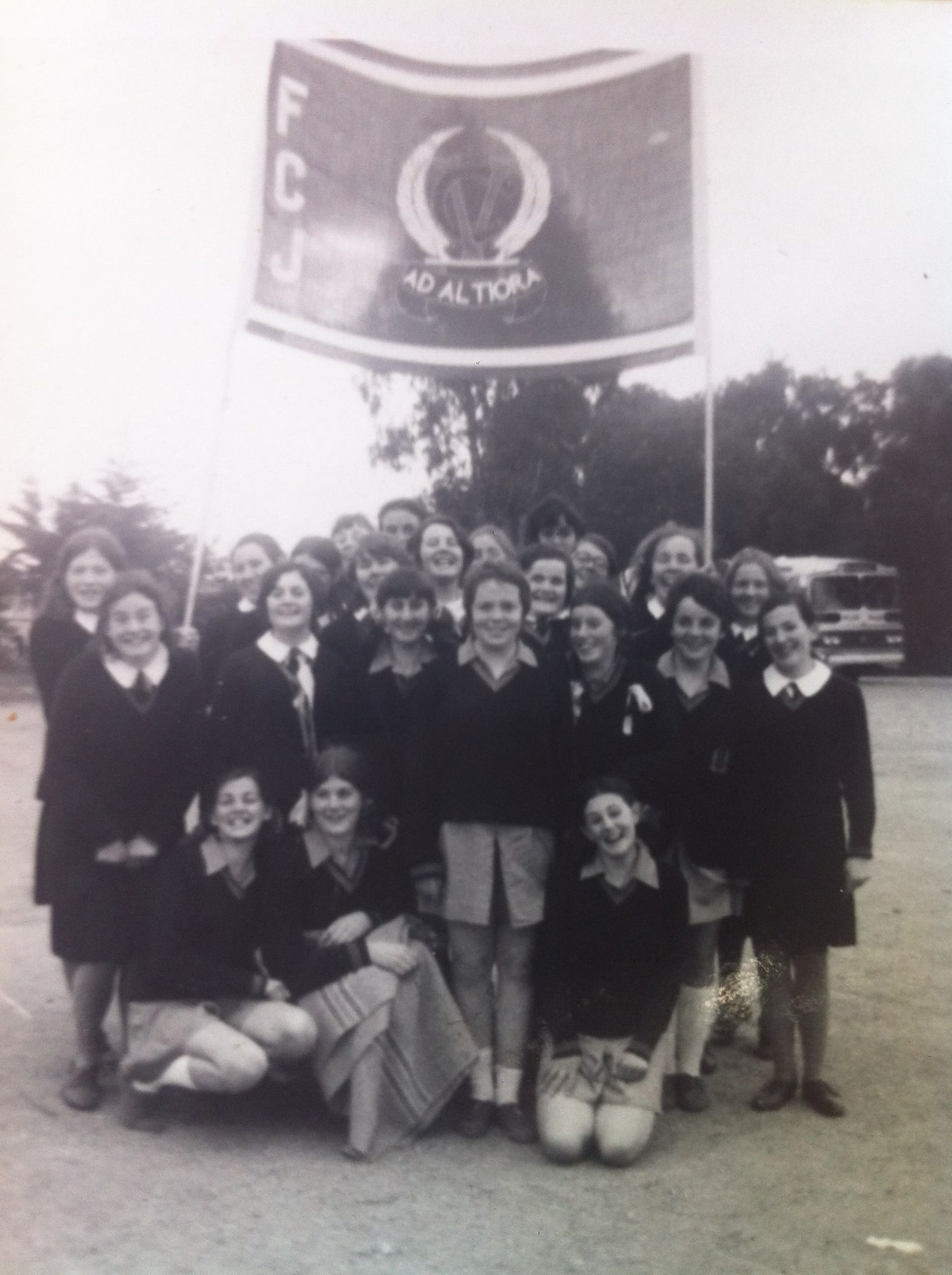
In summer we wore a strict uniform to school. Mushroom pink waisted dresses in linen with a white detachable Peter Pan collar, white gloves, long white socks, brown lace up shoes and a navy blazer, which we wore all year around. Hot and heavy but compulsory for half of the year when the sun blared on us like loud music. As if we were in a desert and even our straw hats, also compulsory, did not offer much shade. Bold girls scrunched their blazers into balls and stuffed them in their school bags only to drag them out when they reached sight of the line of prefects on duty at the school gates.

I was not one such girl. I was obedient. I kept to the rules, most of the time and when I slipped up, my rule breaking was silent and hidden from every single person who might possibly add to the critical voice in my head that told me I was bad. So bad for my sin, for the missal I found in the back of the church on Sunday, one that had a translucent cover of mock pearl with a gold crucifix embedded inside in the front cover. It bore no name and sat forlornly on one of the seats in the back pews. It had no home, nor owner, so why not take possession of that book?

 But as Mrs Milanova, the woman who became my conscience in the form of my psychoanalyst, came to tell me years later, ‘Things that are stolen can never be used.’

She was right. I never used the missal I took from the back seat of the church. Instead, I hid it away in the top of a cupboard where I forgot its existence along with the many other small things I had found left abandoned on the street or in our church.

The past gets swallowed up in the present. A daughter just rang to tell me she has covid. Caught most likely on Friday night when she was out for dinner with a friend. They ate outdoors but from sharing platters and this morning two RAT tests later reveal she is covid positive. 

The friend rang this morning to alert my daughter to the fact that although she is still negative on her RAT test, she has symptoms and her brother who lives with her, has Covid. My daughter was unwell last week with mastitis, feeding her four-month-old. And she took several tests throughout the week, including a PCR on Thursday that came back negative.

So presumably she caught the virus on Friday with her friend. My daughter has no symptoms as such but isolation for the next seven days with two small children in her care and a husband who goes bonkers when confined to the indoors. Not much fun. But hopefully none of them will get too sick. 

When I was a child I knew of contagious diseases, but my mother had instilled in her children a fantasy of immunity that came through our genes. She talked of germs but seemed unworried by them even when two of my siblings contracted rheumatic fever in their teens. She said nothing at the time. Maybe she did not know that this disease came out of a bacterium which entered people’s hearts. Again she might not have known, the incidence of rheumatic fever occurs in indigenous communities, and in ghettos where there is poverty and overcrowding. 

Our childhood struggles were hardly at the level of real poverty, though there was a time when a girl at school told me I was poor. How she had decided this I do not know. Perhaps because when I was in primary school, much to my shame, my mother could not afford to buy leather shoes, the kind worn by most children at Our Lady of Good Counsel school. instead, I wore blue plastic sandals. The buckle up type you still see these days at the height of summer. Blue plastic sandals that I wore with socks at school and after school abandoned the socks. Without socks the sandals collected dirt and the sweat on my skin left black lines on either side of my feet. Dirt that even then horrified me for the way it stuck. My white school socks were equally hard to keep clean given the sandals were wall to wall holes on a thin strip of plastic on which I walked. 

But this was not poverty. This was inconvenience. After the girl told me I was poor I went home and asked, my mother.

‘You’re not poor,’ my mother said. ‘Not if you have a roof over your head and food to eat.’

That sorted it then. A simple solution. A roof over your head, no accounting for its quality and likewise for food.